
If you’ve ever handed scissors, glue, and crayons to a room full of kids, you know what happens next. Someone’s cutting confetti instead of pictures, the glue sticks are vanishing into backpacks, and at least one table is now decorated with construction paper scraps.
Yep, chaos is possible. I’ve been there too.
But that same “uh oh” moment often turns into the most focused learning time of the week. Once students get going, the chatter turns into Spanish. They point, compare, laugh, and talk their way through the activity. And somehow, amid the snipping and sticking, they start remembering vocabulary that used to slide right past them.
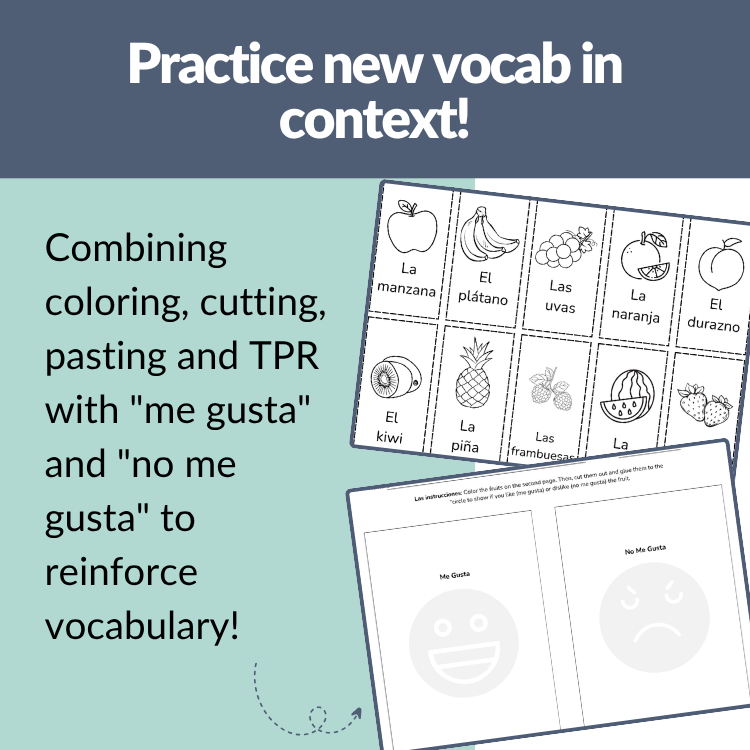
Spanish cut-and-paste activities may look like craft time, but they’re actually memory-making, confidence-building, language-anchoring gold. The resource Cut & Paste: Las Frutas (Worksheet and Full Class Lesson Plan!) blends movement, decision-making, and language in one activity. You don’t just get a worksheet, you get a full class flow where kids talk, move, and learn without the usual meh.
Why Cut and Paste Activities Work
Best Practices for Smooth, Successful Cut and Paste Activities
A good plan makes all the difference. Here are a few ways to make cut and paste work for you, not against you.
- Model First: Show students one completed example so they know exactly what to do. Then, walk them through the first step together. Want to really spice this up? Show them the do’s but really exaggerate the dont’s! Throwing paper around confetti? That’s a golden moment to show some humor while also emphasizing what not to do in a playful way (trust, they’ll remember this rule more than any other!)
- Organize the Space: Set up clear areas for cutting and gluing to help keep materials contained. Spice it up by having 2 students volunteer to demo: one will be the “Si” and one will be the “No”. Whisper instructions to the “Si” student demoing what to do. Encourage the class to applaud and give two thumbs up cheering, “Siiiii!”. Then, do the same for the no (obviously to act out what not to do) and have the student boo and give the student thumbs down while saying, “ Nooooo!”
- Set the Mood: Play light Spanish music in the background while students work. It keeps the energy calm and adds extra language exposure. While you walk around observing, dance a little and playful mimic “me gusta” and “no me gusta” while pointing to their work and encourage them to playful repeat with gestures: “Me gusta la fresa!” would get a double thumbs up in my book.
- Practice Commands: Give cleanup directions in Spanish. Phrases like “Recoge el papel” and “Guarda las tijeras” turn routine tasks into real listening practice. Gestures are going to be your best friend here!
- Earlier Finishers: Have a few earlier finishers? Put them to work, in Spanish, of course because “focused and helpful” beats “glue-stick sword fight” any day.
- Mini Maestros: Have them model your commands for the class. You call out “Guarda el pegamento,” and they act it out dramatically at the front of the room.
- Classroom Helpers: Ask them to give simple commands to their classmates using the same phrases (“Pasa las tijeras,” “Limpia la mesa,” etc.). They love being “in charge,” and it gives them authentic speaking practice.
- Vocabulary Review Crew: Hand them fruit flashcards or small pictures from the activity and ask them to quiz each other using “¿Qué es esto?” or “¿Dónde está la manzana?”
- Spanish Labeling: If there’s time, let them label classroom objects in Spanish using sticky notes—la mesa, la puerta, el libro—for quick, quiet review that builds confidence.
How to Use the “¿Cuántos años tienes?” Worksheets
Once the scissors are snipping, the music’s going, and no one’s glued their sleeve to the table (a win in my book), you’ll feel it, that magical mix of fun and focus. The room is buzzing, but it’s the good kind of noise.
That’s your cue to pivot from setup to substance. You’ve got their attention, their energy, and their curiosity. Now it’s time to turn all that movement into meaningful Spanish practice. Here’s how to use the Cut and Paste: ¿Cuántos años tienes? worksheets to keep hands busy, minds engaged, and language flowing naturally.
Cut & Paste: Las Frutas Activity
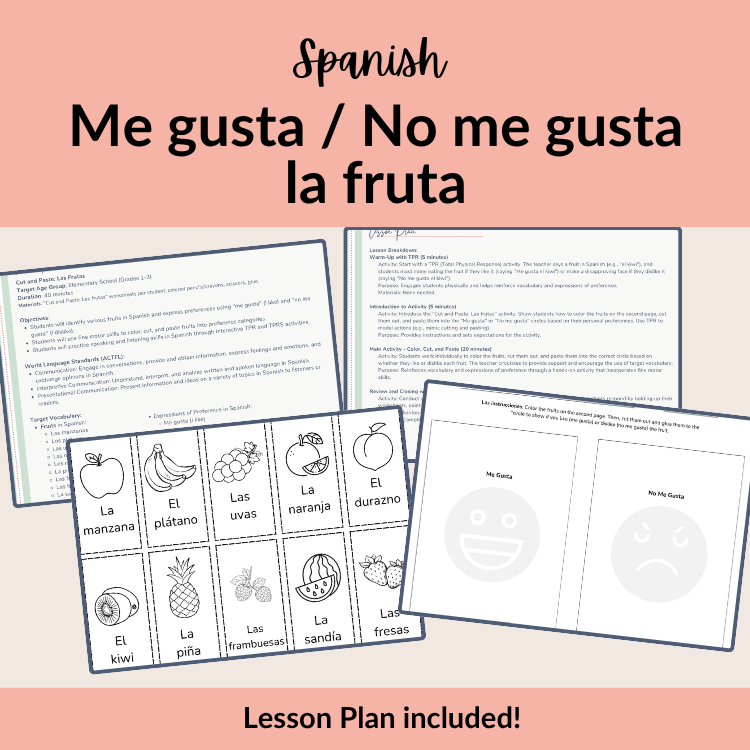
This isn’t “print and hope for the best.” This is a full class experience. Inside the resource you’ll find:
- 1 cut and paste worksheet featuring 10 different fruits
- Las manzanas – apples
- Los platanos – bananas
- Las uvas – grapes
- Las naranjas – oranges
- Los melocotones – peaches
- La piña – pineapple
- Las frambuesas – raspberries
- Las fresas – strawberries
- La sandía – watermelon
- El kiwi – kiwi
- Detailed lesson plan with TPR and TPRS activities, warm-up, speaking practice, and review (you know, everything you need for a full lesson!)
When hands are busy and minds are engaged, language sticks…literally.
Think → Pair → Share: A Simple 3-Stage Activity Flow
You’ve got everything you need for a complete, ready-to-roll lesson — warm-up, TPR, speaking practice, and review. But we’re teachers… and we both know one great activity can stretch way beyond a single class. Why stop at one?
Let’s take this Cut & Paste: Las Frutas lesson and turn it into a full sequence of learning moments that keep your students moving, talking, and using Spanish in fresh ways. Here’s how to extend one simple activity across multiple classes with a Think → Pair → Share flow that keeps engagement high and prep low.
Think (Independently)
Students work on their worksheet. They cut out fruits, decide if they like each one (me gusta) or don’t (no me gusta), and glue the pieces. While working, you walk around and use Spanish phrases: “¿Te gusta la fresa?”
Pair (With a Partner)
Once worksheets are complete, students partner up. Student A asks: “¿Te gusta el plátano?” Student B points to their own sheet and answers: either under me gusta or no me gusta, and then asks back. They alternate, covering all fruits. This gives high-turnover speaking practice.
Share (Small Group or Class)
Finally, in small groups or as a whole class, ask each student to say one fruit they like and one they don’t, using full phrases: “Me gusta la manzana. No me gusta la sandía.” This stage encourages real speaking, no worksheets in sight. Are we scaffolding here? You know it!
(Another) Extension Idea to Keep It Fresh
You’ve already nailed one great lesson with your Las Frutas cut-and-paste activity—but why stop there? You’ve got a goldmine in your hands. Let’s squeeze every bit of value (and vocabulary) out of this one resource. With a few simple tweaks, you can stretch it into multiple lessons for review, movement, speaking, or even assessment, all without reinventing the wheel (or searching for another worksheet).
And the best part? These extensions aren’t just for this activity. You can use them with just about any worksheet you already have. Once you learn how to layer movement, conversation, and collaboration into your lessons, any printable can turn into a full-on, interactive learning experience.
Here are some easy extension ideas to keep things fresh, fun, and fruit-filled long after the glue dries.
Sticky Note Gallery Walk: “Me Gusta” Meets Movement
Give each student two sticky notes and have them label one Me gusta and one labeled No me gusta.
Have them walk around the room and place their Me gusta sticky on a classmate’s worksheet that shows a fruit they also like. Then, do the same with their No me gusta sticky on a worksheet that has a fruit they don’t like.
Once all the sticky notes are placed and the room looks like a rainbow of me gusta and no me gusta, it’s time to bring the class together for a little movement magic. Read each fruit aloud, “La piña,” “Las fresas,” “La sandía”…and have students show their opinions TPR style.
If they like it, they jump up and cheer “¡Me gusta!” like it’s their favorite fruit on earth. If they don’t, they slowly melt to the floor in dramatic despair, groaning “No me gusta…”
It’s silly, quick, and guaranteed to get every kid engaged (even the shy ones). Plus, they’re practicing listening comprehension, reacting to vocabulary, and speaking, all while laughing together. This is the kind of joyful chaos that makes Spanish class unforgettable.
The Gist of it All
Cut & paste activities are more than arts-and-crafts, they are language tools. With Cut & Paste: Las Frutas, your students don’t just build vocabulary, they build confidence, speaking skills, and memory connections. The process is hands-on, fun, and deeply effective.
So when the scissors come out and you hear chattering in Spanish instead of silence, don’t worry about the mess. That’s learning in motion. And it works.