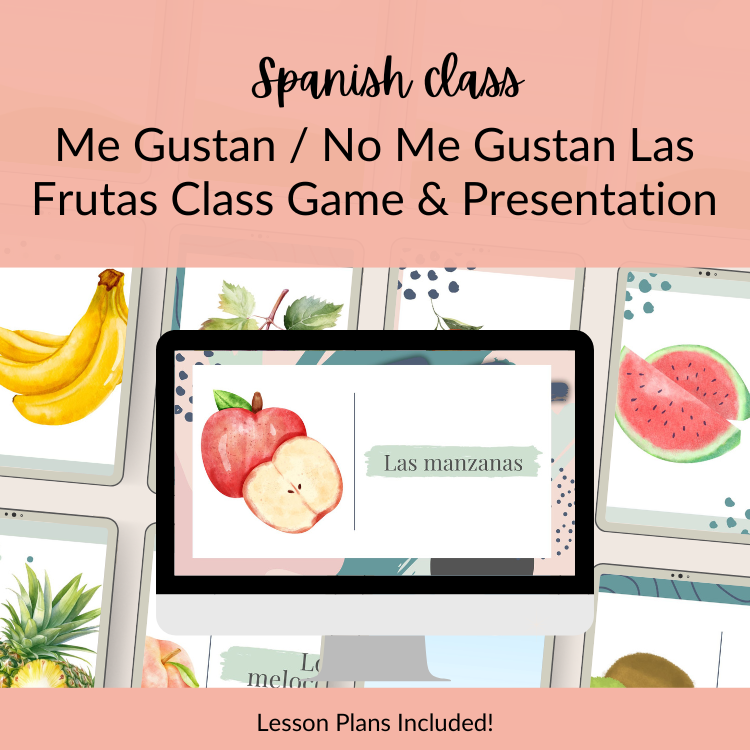
Computer displaying a colorful basket of fruit with a Spanish vocabulary list for Las Frutas Presentation and Game.

Spanish Charades Classroom Activity: When Learning Looks Like Play

Let’s be honest. Some days, teaching vocabulary feels like performing to a brick wall. You say “la manzana,” half the class repeats it, and the rest stare at the ceiling or doodle in their notebooks.

Then you pull out a simple Spanish charades classroom activity—and suddenly, that same quiet student is pretending to juggle apples while their classmates shout guesses in Spanish. The energy shifts, the laughter starts, and before you know it, everyone actually remembers the word.

That isn’t magic. That’s neuroscience. When students combine language with movement—also known as Total Physical Response (TPR)—they activate multiple areas of the brain at once. You’re not just teaching vocabulary; you’re wiring it into long-term memory. And best of all? Students think they’re just playing a game.

Why Charades + TPR Works So Well

We give kids fidget spinners. We let them stand, bounce, and wiggle because movement helps them focus.
So why do we still expect them to sit quietly and memorize vocab lists? Nah. Let’s stop fighting their energy and start using it.

That’s where charades—and Total Physical Response (TPR)—come in. Movement isn’t just a brain break; it’s a memory tool. When students act out “la sandía” or “el plátano,” their brains light up in all the right places. They’re connecting words with movement, laughter, and emotion. Suddenly, vocabulary isn’t just another list—it’s an experience.

And the research totally backs this up. Studies on second language acquisition show that pairing language with movement activates multiple parts of the brain at once, leading to deeper learning and better recall later on (Sousa, 2016; Stevens, 2020). It’s the same reason kids can still remember every lyric and move from a TikTok dance—but forget last week’s vocab test.

So instead of asking them to sit still, let’s lean into what their brains already crave—movement, meaning, and connection. That’s where the real language learning happens.

Teacher Takeaway: When students move with purpose, vocabulary sticks—and joy follows.

Kinesthetic Learning Locks It In : Acting out words builds muscle memory that reinforces language recall.
Lower Stress, Higher Confidence: Gestures take the pressure off speaking and help students participate freely.
Engagement Through Movement: Students want to move and play, so they end up practicing more often.
"We’ve given students fidget spinners, wobble stools, and standing desks—so why are we still asking them to sit still and memorize vocab lists? Let’s work with their need to move. When students act, laugh, and gesture, they’re not just playing—they’re learning faster and remembering longer."
Joyful Journeys in Language Learning

How to Use the Las Frutas Charades Activity

No worries, I’m not going to drop some knowledge and leave you hanging without an easy way to get started! This full game isn’t a “play and hope they learn something” moment. It’s a structured, ready-to-use classroom tool built for real results. The Las Frutas Charades Activity fits beautifully into any Spanish unit—introducing vocabulary, reviewing before an assessment, or serving as an energizing brain break.

What’s inside:

  • A full list of fruit vocabulary (la manzana, el plátano, las fresas and more)
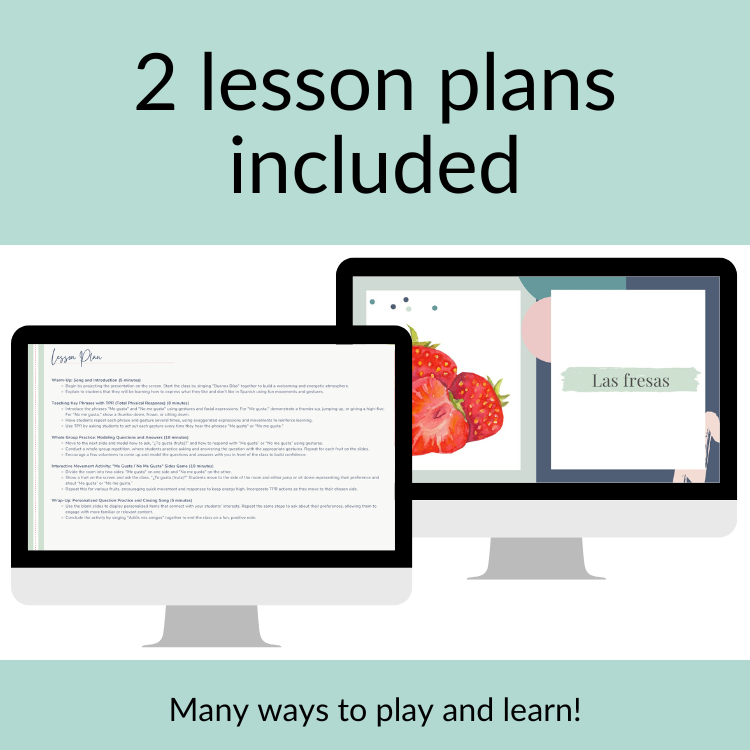
  • Step-by-step teacher instructions for smooth setup
  • Differentiation tips for multiple levels
  • Game variations to keep the fun going all year

5 Classroom Management Tips for Charades That Stay Fun

  1. Set Expectations Early: Explain that only one actor performs at a time and guesses should be made respectfully.
  2. Assign Small Roles: Appoint helpers such as scorekeeper, timekeeper, or game master to involve everyone.
  3. Use a Visible Timer: Keep rounds short and snappy to maintain focus and excitement.
  4. Play in Teams: A little friendly competition boosts engagement and teamwork.
  5. Celebrate Every Try: Whether the guess is right or not, every attempt counts as language practice.

3 Ways to Work Charades Into Your Year

Vocabulary Kickoff
Launch new units with a round of charades. Acting out las frutas or los animales breaks down barriers and gets students speaking.

Brain Break Refresher
Five minutes of charades can reset focus and renew classroom energy mid-lesson.

Pre-Test Review
Replace flashcards with charades to review vocabulary before an assessment. Students show what they know while having fun.

5 Fun Classroom Variations

  1. Guess in Pairs – Two students act together to boost collaboration and creativity.
  2. Silent Round – No sound effects, just gestures and laughter.
  3. Speed Charades – One minute to guess as many as possible.
  4. Student-Directed – Let students lead the game for extra ownership.
  5. Warm-Up Starter – Begin class with a quick round to set a positive tone.

The Gist of it All

Charades isn’t a filler activity. It’s a research-backed, brain-friendly approach that makes vocabulary stick, reduces stress, and transforms your classroom energy.

The Las Frutas Charades Activity makes it effortless: print, play, and watch language come alive. Use it as part of your Spanish Fruits Unit Bundle from the Joyful Journeys TPT shop to scaffold fruit vocabulary across multiple lessons.

Teach language the way the brain loves, through movement, laughter, and meaningful use.

Learn Spanish but make it fun

Resources

Sousa, D. A. (2016). How the Brain Learns (5th ed.). Corwin Press.
Bechtel, S. (2019). The Power of Play in Learning a Second Language. Journal of Language Acquisition, 23(4), 345–361.
Stevens, T. (2020). Active Learning and Its Impact on Language Retention. Educational Psychology Review, 32(1), 75–92.

Leave a Comment

Your email address will not be published. Required fields are marked *