
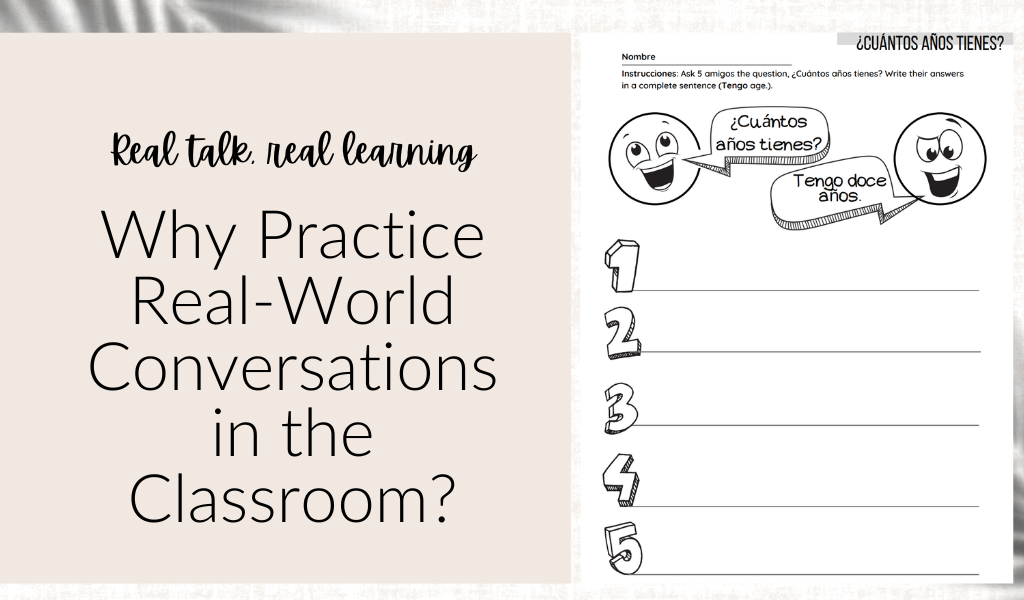
Let’s dive into one of the most practical and effective ways to get your students speaking Spanish in real-world conversations: interviews. When students practice asking and answering questions like “¿Cuántos años tienes?”, they’re not just learning vocabulary; they’re developing conversational skills that are directly applicable in everyday interactions. Today, we’ll explore how interviews facilitate authentic language practice, how to differentiate this activity for students at various proficiency levels, and share some fun classroom tips. Ready to turn your classroom into a conversational hub? Let’s go!
Why Interviews are Essential for Real-World Language Practice
Interviews are more than just speaking practice—they’re a way to build confidence, foster communication, and encourage students to use the language in meaningful ways. Here’s why they’re so effective:
Differentiating Interview Activities for Different Skill Levels
Every student in your classroom is at a different point on their language journey. To make interviews meaningful and effective for all, it’s important to differentiate the activity based on skill level. Here’s a breakdown of the four levels we’ll focus on:
- Novice Learners: These students are just starting out. Their focus is on vocabulary and simple sentence structures.
- Apprentice Learners: These students have a basic understanding of sentence structure and can create simple sentences with support.
- Practitioner Learners: Students at this level are more comfortable with conversational Spanish and can hold basic conversations with minimal support.
- Expert Learners: These students are approaching fluency. They can hold more complex conversations and adapt their language to different scenarios.
How to Differentiate for Each Level:
- Novice: Keep it simple. Provide students with a sentence frame, like “Tengo ____ años,” and let them fill in the blank. Pair them with another novice learner, so they can practice without feeling intimidated. If needed, allow them to use a number chart as a reference for counting.
- Apprentice: Have students ask and answer the question “¿Cuántos años tienes?” in pairs. Provide them with visual aids (like number charts) but encourage them to try without looking first. Pair them with a practitioner to help guide them through the process.
- Practitioner: Challenge practitioners to expand their answers. Instead of just “Tengo ocho años,” encourage them to add details like, “Tengo ocho años y mi cumpleaños es en mayo.” They can be paired with novice learners to provide support, or with fellow practitioners to engage in more detailed conversations.
- Expert: Experts should be encouraged to ask follow-up questions like, “¿Cuándo es tu cumpleaños?” or “¿Qué hiciste para celebrar tu cumpleaños?” Pair them with other experts to deepen the conversation or with apprentices to model more complex language.
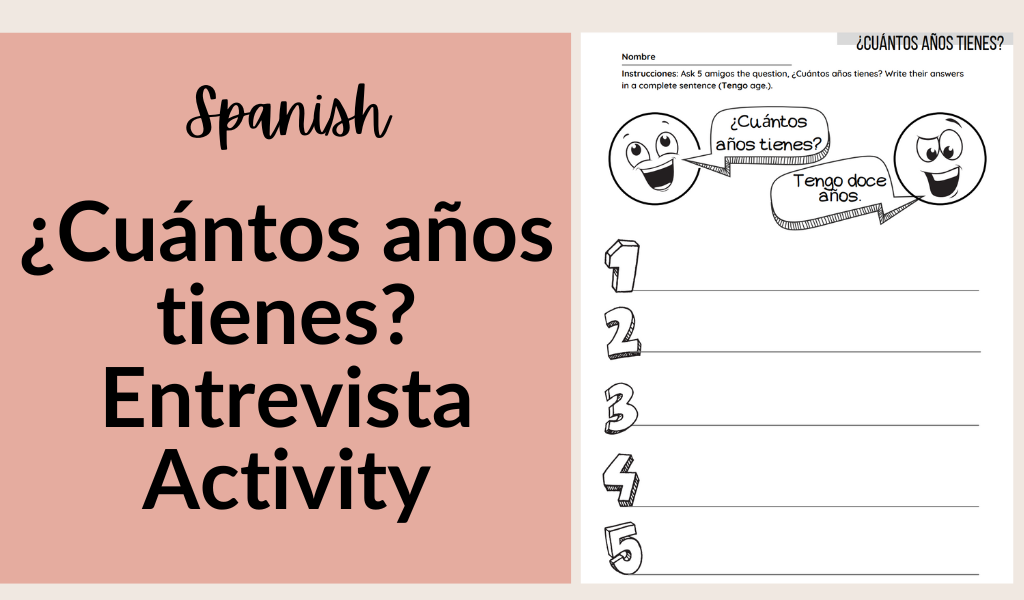
Get Your Resource: ¿Cuántos años tienes? Entrevista
Common Pitfalls and How to Avoid Them
As with any classroom activity, there are a few potential pitfalls to watch out for when conducting interviews. Here’s how to avoid them:
- Pitfall: Uneven Partner Pairing: Avoid pairing two students who are too far apart in skill level without a clear purpose. If a novice student is paired with an expert without support, they may feel overwhelmed or frustrated. Fix: Balance the pairings based on the goals of the activity. If you want experts to guide novices, give them a clear role—like helping their partner form complete sentences.
- Pitfall: Lack of Structure: Without clear expectations, interviews can quickly turn into unrelated conversations. Fix: Set clear expectations before starting. Let students know what they should be asking and answering, and provide a simple structure (like asking the question five times).
- Pitfall: Overwhelming Novice Students: Jumping straight into an unscripted interview can be too much for beginners. Fix: Give novices sentence frames and support tools, like vocabulary charts, to ease them into the activity. Gradually reduce the support as their confidence grows.
Introducing the “¿Cuántos años tienes?” Interview Activity
The “¿Cuántos años tienes?” Interview Activity is a simple, effective tool to help students practice this key phrase in a fun and meaningful way. Here’s how to use it in your classroom:
- Partner Interviews: Students ask five different classmates, “¿Cuántos años tienes?” and record their answers in a complete sentence (“Tengo ocho años”). This helps reinforce number vocabulary and conversational skills.
- Whole-Class Walkabout: Get students moving by having them walk around the room, interviewing as many classmates as possible within a set time. The goal? To ask and answer as many times as they can! This keeps the energy up while practicing language.
- Role-Playing: Pair students up and give them roles to play. One student can be a news reporter, and the other a celebrity. Have the “reporter” ask the “celebrity” questions about their age and birthday plans. This adds an element of fun while encouraging real-world application of the language.
3 Ways to Use This Activity in the Classroom
- Warm-Up Exercise: Start class with a five-minute warm-up where students ask each other “¿Cuántos años tienes?” This gets them speaking Spanish right away and sets the tone for an interactive lesson.
- Classroom Survey: Turn the interview into a survey! Have students ask the question to five friends and create a graph showing the ages of their classmates. This combines language learning with math skills for a cross-curricular activity.
- Guess the Age Game: After completing the interviews, play a game where students have to guess how old their classmates are based on their earlier conversations. It’s a fun way to review the vocabulary and keep students engaged.
The Gist of it All
Interviews are an excellent way to bring real-world language practice into your classroom. By differentiating for different skill levels and setting clear expectations, you can ensure every student feels successful and confident. The “¿Cuántos años tienes?” Interview Activity is a great tool for practicing numbers, sentence structure, and conversational skills—all while having fun!
Resources
Ellis, R. (2015). Understanding second language acquisition. Oxford University Press.
Lightbown, P. M., & Spada, N. (2013). How languages are learned (4th ed.). Oxford University Press.
VanPatten, B., & Williams, J. (2015). Theories in second language acquisition: An introduction. Routledge.